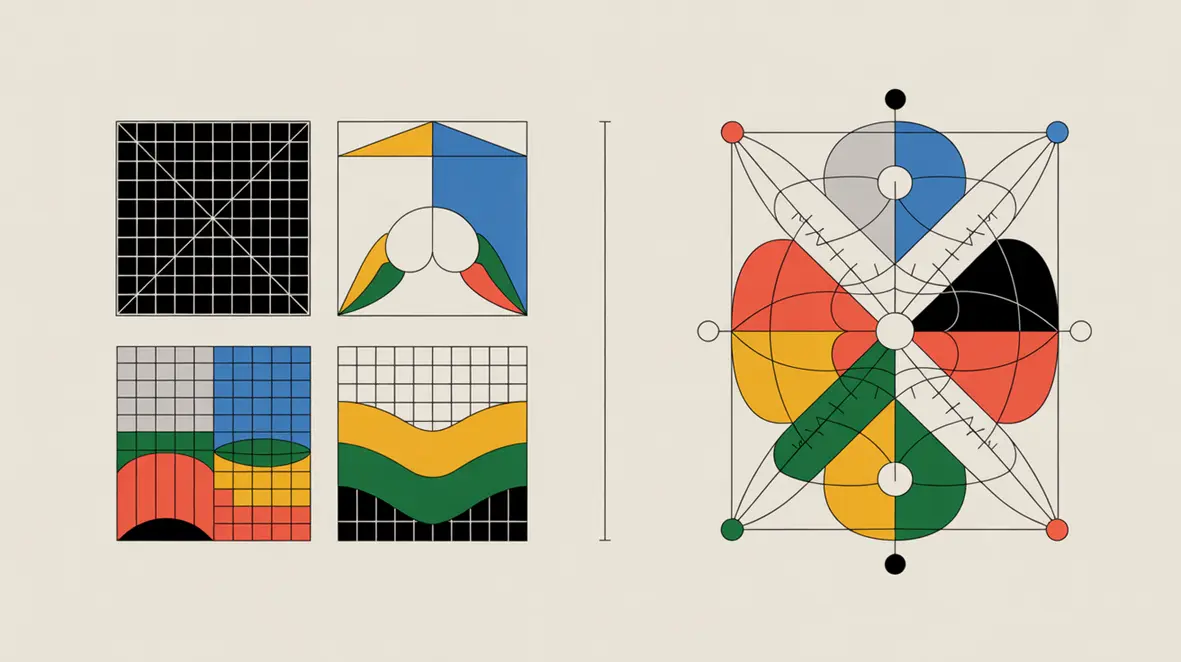


Schools divide knowledge into subjects. The world does not. A doctor at a bedside weighs biology, communication, and ethics in the same minute. A policy analyst holds economics, history, and law in view at once. The questions that decide anything of consequence almost never arrive sorted by department. Integration is the fifth mode of thought. It crosses the lines of distinction a school may draw, and brings several disciplines to bear on a single question. Integration is what the eight-subject core is ultimately for. In our experience, it is also the rarest of the five, as the mode of thought that learners in many conventional schools rarely get to practice.
Why is Integration so rare?
There are structural roots to why Integration is not taught. Most schools are organized around disciplines that operate in silos. The mathematics educator teaches mathematics, the literature teacher delivers literature, and the science teacher explores science. Learners move between subjects as though they are separate terrains. No part of the academic infrastructure invites them to put the worlds together. By the end, learners have accumulated content in each field but cannot articulate its connections. They become competent within disciplines, but less so between them. That makes them underprepared for adult life. Many young adults, therefore, spend several years after school trying to formulate practices and habits of Integration on their own, because their personal, professional, and public lives require the skill.
How we cultivate Integration
At Franklin Global, learners are regularly given assignments that draw on two or more subjects at once. For example, a question about habitat in Environmental Science may require knowledge of life (Biology), matter (Chemistry), human experience (People and Society), and quantity (Mathematics). Our capstone case study projects and becoming performances also routinely cross subjects, which makes Integration their central operation.
Mentors at Franklin Global are chosen for their integrative experience. We seek out professionals whose jobs involve the exercise of thought and decision making across subjects. A working engineer must have a strong interdisciplinary foundation, spanning the core sciences, advanced mathematics, modern computing, specialized engineering branches, and more. An entrepreneur would do well to have competency in science, technology, engineering, mathematics, language, social studies, and literature.
Our educators are picked for their expertise in specific disciplines and their generally applicable knowledge across subjects. That is because our disciplines are all tapestries that weave in elements of the other subjects around and throughout their topical core. Our pedagogical approach sees scaffolding as a conceptual dialogic bridge. It gives Integration grammar and logic of its own to support communication between educators, tutors, and learners. It confirms how terms, concepts, frameworks, rubrics, theories, and philosophies can be coherent both within and between disciplines.
People who solve the challenging problems
Take a city deciding whether to build a seawall. It looks like an engineering question, and an engineer can say precisely how high the wall has to stand. But it is also an economic question about who pays for it, a political one about whose street might flood if the budget falls short, an ecological one about the marsh that the wall might smother, and an ethical one about who gets a vote. In this scenario, it is possible for a team of specialists to provide accurate responses to these questions from each of their professional perspectives, yet still fail to arrive at a workable solution to meet all requirements. That is because solutions are often situated in the gaps between fields. Finding those gaps and working within and across them is where integrators thrive and feel most at home. Integrators can hold several ideas together in productive tension. They know what levers to pull, what ingredients to combine, and how to coalesce support for solving complex problems. At Franklin Global, we place a premium helping learners become integrative thinkers.
Bringing the five modes of thought together
Integration comes last. It is the functional node where the other five modes meet. To bring diverse subjects to bear on a single question, a thinker must first read each field’s role (Interpretation). They must ask consequential questions (Inquiry), verify claims (Investigation), and, as required, construct new value at the seam (Innovation). Integration connects the capabilities of these other four modes into a symbiotic whole. With Integration as their glue, they together serve as an effective operating system. They form a unified thought machine that thinkers can harness to shape their growth and becoming in the classroom and the world.
Collectively, Interpretation, Inquiry, Investigation, Innovation, and Integration are the cognitive architecture of a Franklin Global education. They help us ignite real sparks of genius in every learner. They give thinkers the intellectual tools and roadmaps they require to navigate reality meaningfully. They also support learners’ curiosity and confidence, as they discover how to become who they choose to be in a world that needs to see them authentically.
As educators, our investment in this mode-of-thought operating system is deliberate. We hold ourselves accountable for the outcomes it produces in the young people who we send into society. We are banking on this operating system to help our learners become increasingly informed, knowledgeable, wise, trustworthy, and resourceful throughout life.