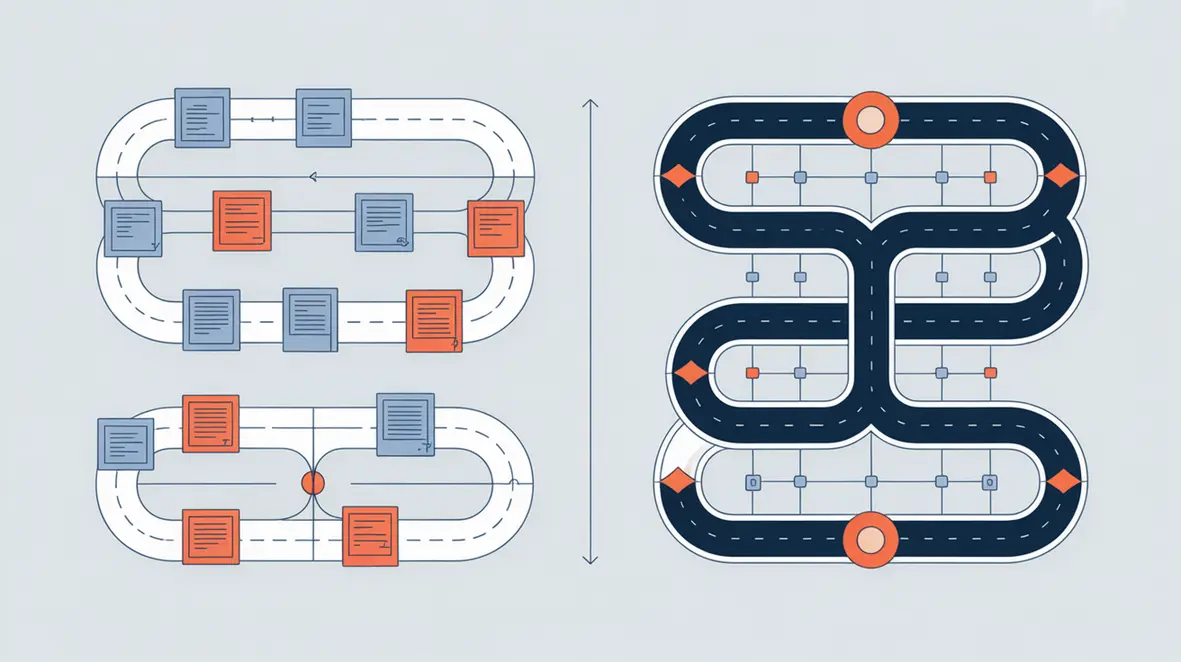


An extraordinary machine for knowledge
A modern school is one of the most carefully engineered institutions we have. The path through algebra is mapped years ahead, each concept set before the next, every lesson sequenced, assessed, and revised the moment a student falls behind. We can say with precision how a fourteen-year-old is doing in chemistry, or in the reading of a difficult poem. Over a century, we have built an extraordinary machine for moving a young mind through a body of knowledge.
Almost nothing for what comes after
For what comes after that knowledge, we have built almost nothing.
Ask how the same fourteen-year-old is progressing toward a life, toward work that suits them, toward some place in the world that needs what they are good at, and the machine goes quiet. There is no syllabus. There is no sequence, no assessment, no patient revision. In most schools, the whole of it falls to one counselor carrying several hundred students, an afternoon career fair in the gymnasium, and a rack of brochures. The most consequential passage a person ever makes is the single part of their education left almost entirely to chance.
Not an oversight but an inheritance
This is not an oversight so much as an inheritance. The comprehensive school was designed roughly a century ago. It was intended to do two things, namely transmit a shared body of knowledge and sort the young by measured ability. Guidance came later, bolted to the side and chronically under-resourced. The institution’s central work became the curriculum, and the passage into adult life was quietly handed to two other forces, the labor market and the family.
A matter of justice
It is in that handoff to the family that the design becomes a matter of justice. When a school declines to build a path into the world, families build it instead, and families are not equal. The sociologist Annette Lareau gave the affluent version a name, concerted cultivation. It refers to the parents who arrange the internship through a colleague, who make the introduction to someone in the field, who turn a summer into the first rung of a career. Mark Granovetter showed half a century ago that opportunity travels along social ties, and a well-connected child inherits those ties at birth. A school that leaves the future to luck is therefore not neutral. It ratifies the advantages some children already carry and shrugs at their absence in others. The gifted child without a network never even learns the door was there.
The remedy
The remedy is not a better brochure or a more stirring assembly. It is to treat the passage into the world as something a school designs and teaches, with the seriousness it brings to a discipline, and to make that passage an institutional duty rather than a private family asset. Picture the transition to adult life given an actual curriculum. It would involve a vetted, current map of the options beyond school, followed from the early grades; a counselor who brokers an introduction when a student is ready; a real interview, a real project, an apprenticeship that counts, all of it advised and sequenced year over year, the way any subject is. Picture, above all, the same door opening for the child in the small town as for the child in the capital, because the institution is the one holding it open, not the family’s address book.
How a school should be judged
This is the problem we set out to solve in building Franklin Global, and it is the structure we built to meet it. I will not pretend the work is finished, or that it is simple. But the principle beneath it is not complicated, and it is overdue. A school should be judged not only by what its graduates know on the day they leave, but by whether the world is open to them when they walk out the door, and by whether that openness owes anything at all to luck.